Transactions on Machine Learning Research, July 2026

Revisiting Learning-based Video Motion Magnification for Real-time Processing

Hyunwoo Ha1,* Oh Hyun-Bin1,* Kim Jun-Seong1 Kwon Byung-Ki2 Kim Sung-Bin1 Linh-Tam Tran3 Ji-Yun Kim1 Sung-Ho Bae3 Tae-Hyun Oh4
1POSTECH EE 2POSTECH GSAI 3Kyung Hee University 4KAIST School of Computing

*Equal contribution

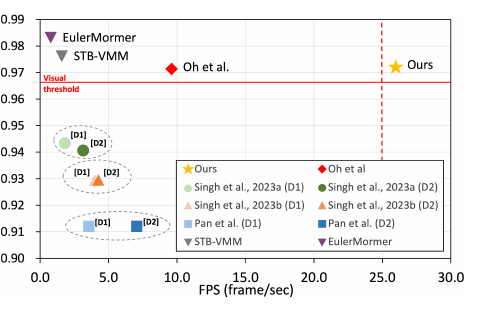
Computational speed comparison of learning-based video motion magnification models.
FastDMM is the only learning-based method above the 25 FPS real-time threshold while maintaining favorable motion magnification quality.

Abstract

Video motion magnification captures and amplifies subtle motion in a video that is invisible to the naked eye. Prior learning-based methods improve generation quality over conventional signal-processing approaches, but they still fall short of real-time performance, limiting their use in online systems.

We revisit the first learning-based motion magnification model and analyze redundant components, spatial bottlenecks, and the trade-off between channel reduction and layer addition. By integrating these findings, we present a real-time learning-based motion magnification model that is 2.7x to 34.9x faster than existing learning-based methods while maintaining perceptually sufficient generation quality.

To the best of our knowledge, this is the first learning-based motion magnification model that runs in real time on Full-HD videos without ad hoc quantization.

What We Revisit

The paper starts from the first learning-based motion magnification model and studies which architectural components are essential for efficient Full-HD processing.

  • Encoder redundancy and the effect of simplifying feature extraction.
  • Spatial bottlenecks for faster frame reconstruction.
  • Channel reduction and decoder depth trade-offs for quality recovery.

Main Result

25+ FPS real-time Full-HD processing
2.7x-34.9x faster than existing learning-based methods
0.966 human-calibrated visual quality threshold

Architecture Analysis

Baseline architecture for learning-based video motion magnification.

The analysis decomposes the baseline into encoder, manipulator, and decoder stages, then studies how to remove redundant computation while preserving motion magnification quality.

BibTeX

@misc{ha2024revisiting,
  title         = {Revisiting Learning-based Video Motion Magnification for Real-time Processing},
  author        = {Ha, Hyunwoo and Oh, Hyun-Bin and Kim, Jun-Seong and Kwon, Byung-Ki and Kim, Sung-Bin and Tran, Linh-Tam and Kim, Ji-Yun and Bae, Sung-Ho and Oh, Tae-Hyun},
  year          = {2024},
  eprint        = {2403.01898},
  archivePrefix = {arXiv},
  primaryClass  = {cs.CV},
  doi           = {10.48550/arXiv.2403.01898}
}